


The Hidden Cost of Manual Contractor Payouts | GIM Pro Blog
The Hidden Cost of Manual Contractor Payouts
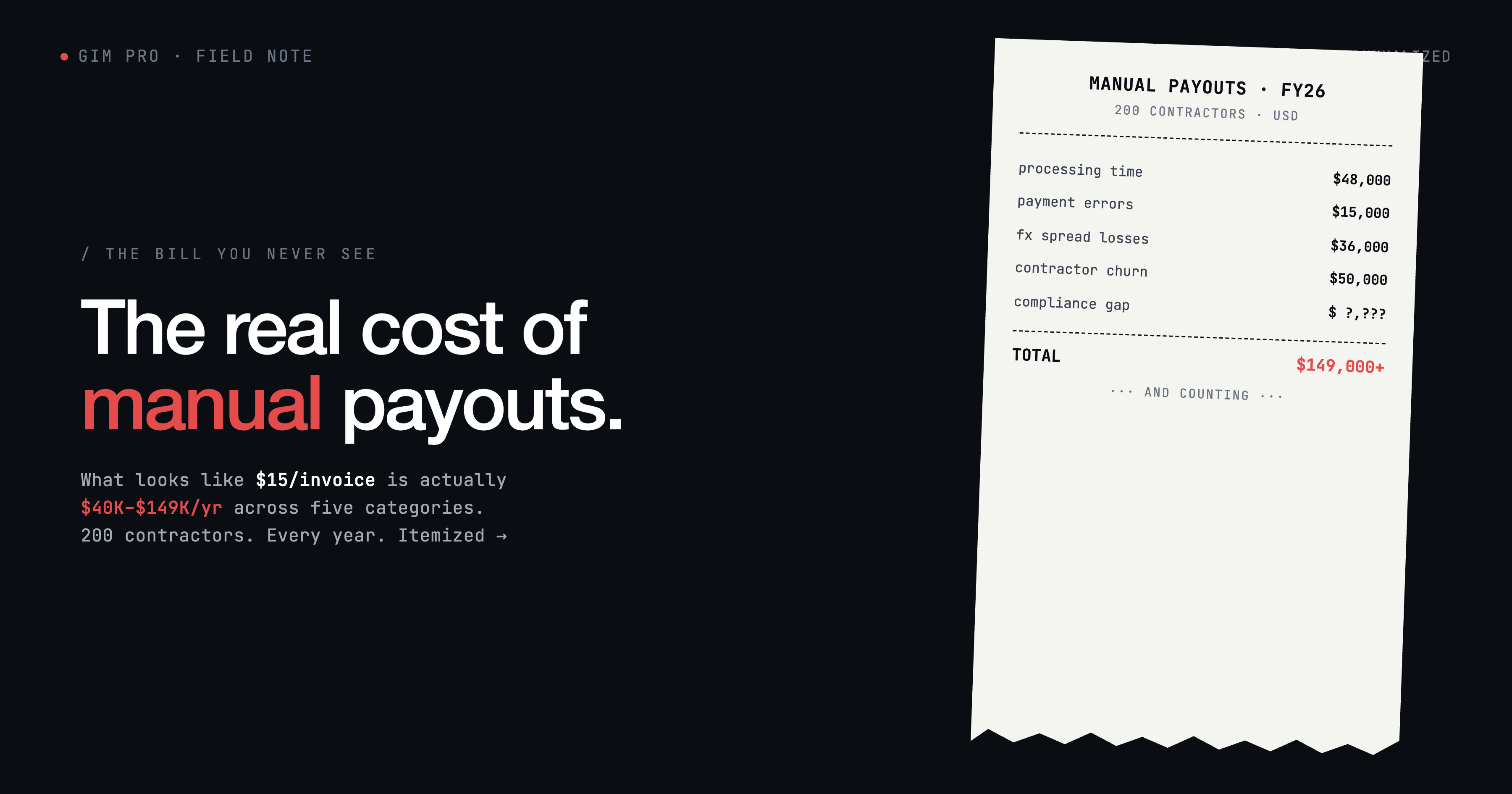
Every Tuesday at 6 AM, a finance manager at a 50-person agency opens three browser tabs: one for the company bank portal, one for PayPal, and one for a crypto exchange. She has 40 invoices to reconcile and 12 currencies to convert. By noon, she has processed the payouts. By Thursday, three contractors email to say the amounts don't match. One flags a $200 FX discrepancy; another hasn't received the SWIFT transfer at all.
This isn't a horror story — it's a weekly routine for finance teams that still rely on manual contractor payouts. And the real cost of that routine is far higher than most companies realize.
1. Time: The Silent Budget Drain
According to a 2024 invoice processing cost study by Tipalti, the average cost to process a single supplier invoice manually ranges from $5 to $20 when factoring in labor, approval cycles, and error correction. For companies managing 50–200 contractor payouts per month, that translates to $9,000–$96,000 per year spent on payment processing alone — before any errors occur.
According to the Institute of Finance & Management (IOFM), AP teams spend roughly 50% of their time on manual, low-value tasks such as data entry, payment reconciliation, and chasing approvals. For growing companies with distributed contractor networks, this time compounds quickly: every new hire in a new country adds another bank format, another currency, another set of compliance paperwork.
2. Payment Errors: Small Mistakes, Expensive Consequences
Manual data entry is inherently error-prone. According to AP automation statistics compiled by Stampli, manual invoicing processes typically lead to error rates of around 2% per batch, with a Gartner study finding that 18% of accountants make daily errors. When those errors involve international wire transfers — wrong SWIFT codes, incorrect IBAN formats, or mistyped beneficiary names — the cost per error can include bank investigation fees ($25–$50 per inquiry), re-processing charges, and delays of 5–14 business days.
For contractors waiting on payment, delays aren't just an inconvenience. They directly erode trust. According to Payoneer's 2023 Freelancer Insights Report, based on a survey of over 2,000 freelancers across 122 countries, payment terms and reliability are among the top factors influencing whether freelancers continue working with a client. In competitive markets for engineering, design, and marketing talent, late payments push top contractors toward companies with smoother payment operations.
3. FX Losses: The Margin You Never Budgeted For
When finance teams process cross-border payments manually — especially through traditional banks — they rarely get favorable exchange rates. Banks typically mark up the mid-market rate by 1.5% to 3%, and this markup is almost never disclosed transparently.
To put that in perspective: a company paying $100,000 per month to contractors in non-USD currencies could be losing $1,500–$3,000 monthly on FX spreads alone. Over a year, that's $18,000–$36,000 — a line item that almost never appears in budgets because it's buried in transaction receipts.
According to the World Bank's Remittance Prices Worldwide database, the global average cost of sending $200 cross-border remains around 6.2% as of Q4 2024. While B2B transfers are typically cheaper than consumer remittances, the principle holds: legacy banking rails impose a hidden tax on every cross-border payment, and companies processing payouts manually have no leverage to reduce it.
4. Contractor Churn: The Cost No One Tracks
Most companies measure employee retention. Very few track contractor retention — even though replacing a skilled contractor often costs more than replacing a full-time employee, once you factor in sourcing, onboarding, knowledge transfer, and the ramp-up period.
According to research on freelancer retention by Expert360, payment experience is one of the strongest predictors of whether contractors continue working with a particular client. Inflexible or slow invoice payment policies are cited as a key friction point that discourages top talent from returning.
For agencies and tech companies that rely on contractor networks as a core operational capability, the downstream cost of this churn is significant: lost project continuity, repeated ramp-up periods, and reduced output quality during transitions.
5. Compliance Risk: The Ticking Time Bomb
Perhaps the most underappreciated cost of manual payouts is regulatory exposure. When companies send payments to contractors across multiple jurisdictions, they're subject to anti-money laundering (AML) regulations, tax withholding requirements, and sanctions screening obligations in each relevant country.
Manual processes make it nearly impossible to maintain consistent compliance documentation. A missed 1099 filing in the US, an incomplete KYC record for a contractor in Southeast Asia, or an undocumented crypto payment can each trigger penalties. According to IRS data on returns filed and penalties collected, the agency collected over $4 billion in penalties related to information return failures in recent fiscal years — a category that includes misreported or unreported contractor payments.
As regulatory scrutiny of cross-border payments intensifies globally — according to the FATF's update to Recommendation 16 on Payment Transparency, countries are now required to ensure greater data sharing and traceability in international transfers — companies without auditable, documented payout workflows face increasing exposure to fines, frozen accounts, and reputational damage.
The Real Cost: A Quick Framework
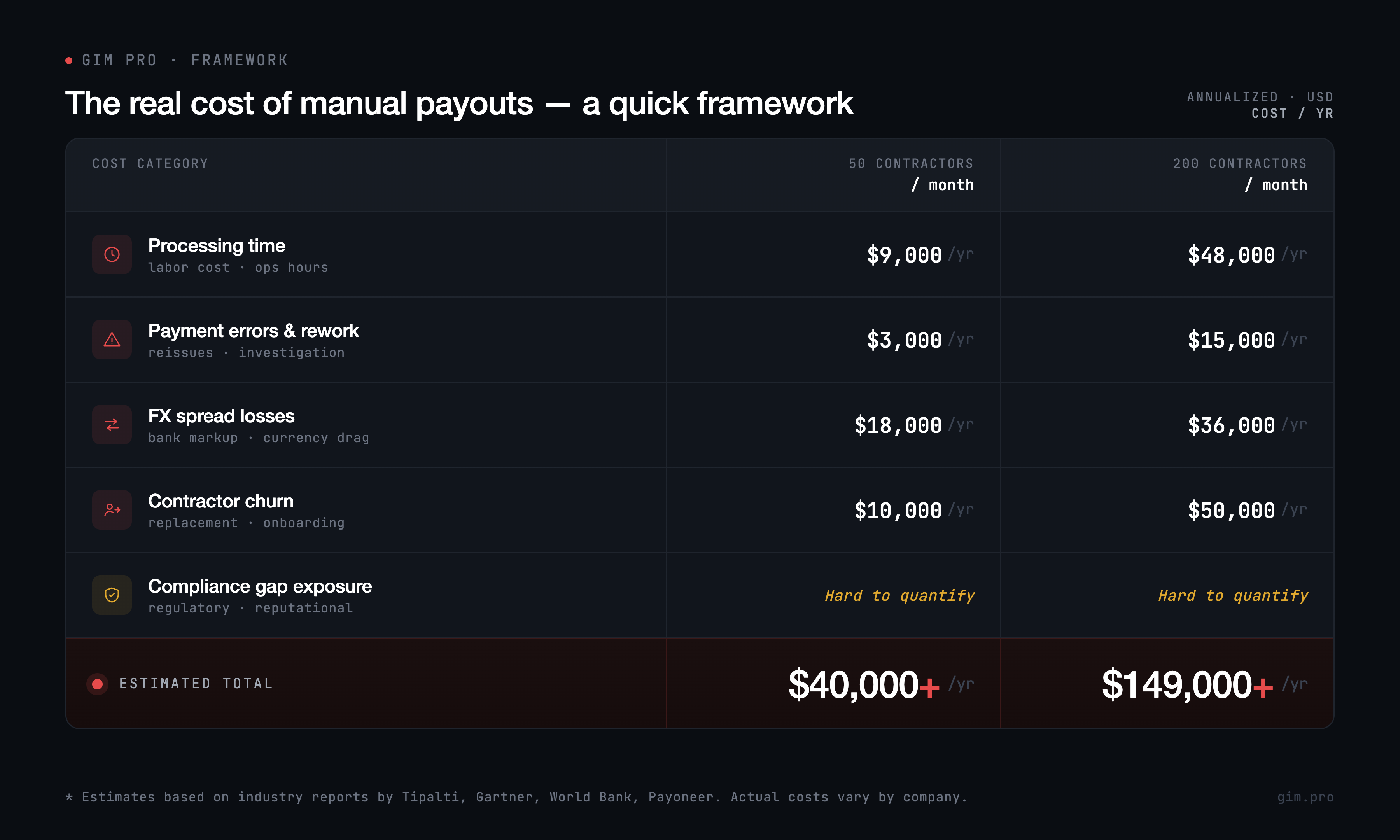
Here's a simplified way to estimate what manual contractor payouts actually cost your company:
 !
!
These numbers don't include the opportunity cost of what your finance team could do if they weren't manually processing payments every week.
What the Shift Looks Like
The companies eliminating these hidden costs share a common pattern: they consolidate contractor payouts into a single platform that handles multi-currency disbursement, compliance documentation, and method selection automatically.
Instead of managing three bank portals, a PayPal business account, and a crypto exchange separately, they upload one CSV or connect an API — and every contractor receives payment in their preferred method, whether that's a SWIFT transfer, PayPal, SEPA, or USDT.
GIM Pro is built for exactly this scenario. Licensed under FINTRAC (Canada's financial intelligence unit) and supporting 10+ payout methods across 97 countries, GIM Pro lets companies fund a single account and pay their entire contractor network — in any currency, via any method — with full compliance documentation and an audit trail for every transaction.
No monthly per-contractor fees. No hidden FX markups. No compliance gaps.
Ready to see what your company is actually spending on manual payouts? Book a demo →